Showing posts with label Environment Wellness. Show all posts

Saturday, March 8, 2014

Visit to Terra Biodynamic Organic Farm

Organic Wellness meetup @
mud house Terra Farm
Just last weekend,
I gathered some members of Organic Wellness Meetup
and a few of my nutrition course students to
visit Terra Biodynamic Organic Farm @ Blue Valley
which is about 1.5hr drive from Cameron Highlands.

I heard so much about Terra Farm
for a long time,
be it for their famous mud house, exotic "tree-motel"
or their vibrant, tasty organic produce.
But never did I find a decent time to visit them
due to the distance of travel and my busy schedule
until recently.

Despite the long distance of some 250km from Kuala Lumpur
and having to rush to and fro within a day,
it was a very rewarding one day educational trip!

At the farm,
we received 2hours biodynamic farming lecture
and another 1 hour of farm touring conducted by
the farm owner, Mr Ng
who opened our eyes to more indepth understanding
about organic farming
and biodynamic skills to boost life force of organic produce!!

Some of the important points I gathered from Mr Ng:

1. A strong and healthy crop can naturally wade off pests on its own,
due to strong defence system.

2. The life force and health of a crop rely on the health of the soil.

3. Conventional organic composts
do not supply good enough amount of nutrients,
to offer life force to the crops and help build up their defence systems.

4. Biodynamic organic skills focus on fermenting nourishing compost
which "stores" nutrients in colloidal form in the soil.

5. The colloidal form of nutrients prevent over absorption of nutrients
during evening time, otherwise will cause intoxication of the crop,
and easily leached away .

6. Crops that grow on biodynamic compost
have got two distinctive features
i. webby feeder roots which penetrate colloidal soil structures for nutrients
ii. naturally waxy leaves

7. Biodynamic compost is different from normal organic compost,
in the process of fermentation where, over-heating and over-tossing
are avoided, to minimize nutrients loss (oxidised).
It's meant to imitate humus top soil of primitive jungle.

The biodynamic lecture mainly focused on topics of soil health and compost,
But, there are actually many other ways to grow a crop biodynamically,
In fact, biodynamic farmers also apply other techniques
to boost the growth and life force of crops.
As Mr Ng briefly mentioned,
there is a natural technique to make the soil more reflective of sunshine
to encourage more photosynthesis,
so that the plants grow faster and strong naturally
(just like plants that grow by the seaside receiving more reflective sunshine)
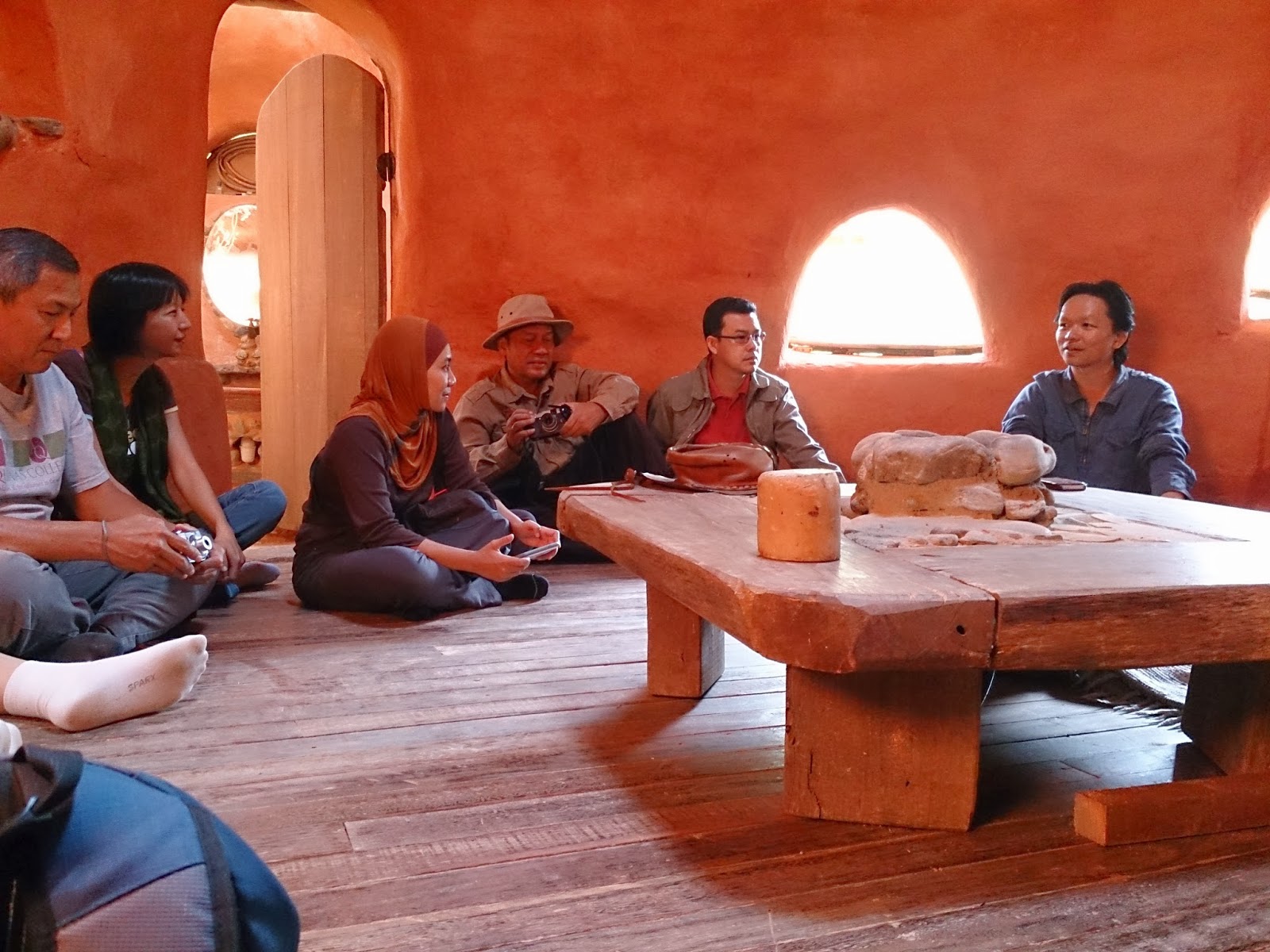
Mr Ng and tour mates
in mud house living room
Mr Ng, delivering Biodynamic Lecture


After the enriching lecture,
we all had a buffet style organic lunch,
which was prepared by Mr Ng's wife, Ms Wanjing.
The Biodynamic vegetables were truly tasty
even cooked plain, with only sea salt (ie no other condiment)!

The vegetables themselves had their own flavours,
as Mr Ng emphasized.

Biodynamic Buffet time
Biodynamic dishes


After lunch, we had another lesson in the field,
checking out
how biodynamic feeder roots look like,
how the naturally waxy leaves were shiny and robust,
how biodynamic composts were colloidal, moistened and spongy.
Absolutely intriguing!

Biodynamic Veggie
with Feeder Roots Systems
Waxy leaves of healthy
Biodynamic Coffee Plant
Biodynamic carrot with
strong flavour & aroma


This one day trip was truly a learning experience.

The organic agriculture has always been accused of being
inefficient in yield and uneconomical.
we were provided evidence in front of our eyes,
that organically grown crops could robust, big and strong.
The critical point lies in the faith and
the passion to research for better ways to nurture organic crops =)

May organic agriculture prevails!

Feeling blessed,
Kee Yew
pureland2012-at-gmail.com

. Terra, Organic, Biodynamic

{Learning Holistic Wellness for Wisdom and Compassion}

Saturday, July 27, 2013

GMO -- The Real Food Crisis 转基因危机

The Prevalence of GMO
All along, I have been longing for an opportunity to
elaborate on the critical issues about our food supply nowadays,
especially on Genetically Modified Organisms (GMO) crops.
-- Generally, the public understanding on GMO is lacking.

GMO crops is one big hazard,
not only to our health, the survival of mankind and the biodiversity,
but also to the economy and social culture.

On 16th June 2013, I gave an seminar,
exclusive to Vegetarian Wellness Course students at Sagamudra Buddhist Society,
on the in and out of GMO crops, explaining in details
what GMO is,
when GMO started,
why GMO is created,
how GMO bring irreversible consequences
and
the fundamental solutions.
[this seminar was delivered in Mandarin]

一直以来, 我都很想有个机会
细细道来我们现今社会的粮食危机,
尤其是转基因农作物的过患。
-- 一般大众对基改作物依然是贫乏的。

基改作物不但会危害健康、人类的生存和多元生态,
同时也为经济和人文带来困境。

2013年6月16日,
我在新加坡海印学佛会,给素食营养课的同学,
讲演基改作物(GMO)的相关课题,
阐述GMO的来由、技术、历史、副作用
和解决对策等等。


Discussion is welcome :)
欢迎共同讨论课题!


Well regards,
Kee Yew
pureland2012-at-gmail.com


#GMO


{Learning Holistic Wellness for Wisdom and Compassion}

Thursday, September 8, 2011

A dinner worth celebrated for

It was an amazing evening last Saturday,
when I brought my Organic Living meetup group
for a raw organic vegan dinner at Green Room Cafe.

At this rare event, I was totally mesmerised among
the classy al fresco ambience at the cafe,
the creative and deliciously raw Balinese dishes,
and the company of 16 (environmental-)friendly organic goers!

The unique dishes we had was not even in the cafe's usual menu.
Diana von Cranach the raw chef personally "orchestrated"
the entire series of raw dishes
specially for us -- to celebrate
Living health food, Veganism and Organic Living
3 in one go! hahaha... :D


Raw Organic Vegan
Menu


Carrot "Rice" with
Curry Vegetable


Living Biscuit with
Papaya Soup


Raw Chocholate Mousse
with Mango


Organic Goers with
Diana von Cranach


What was truly precious about this dinner
was meeting the like-minded people,
people who seriously care about
environmental health,
organic farming and
have big compassion for the animals.

Diana also shared with us how
organic living should start with
fresh foods and
knowing the kind hearted people who farm for our food.

We started the dinner gathering at around 6.30pm,
but none of was willing to leave until it was 10pm-ish...
Great moment always seemed so short =)


Warm regards,
Kee Yew
pureland2012-at-gmail.com


{Learning Holistic Wellness for Wisdom and Compassion}


Sunday, August 28, 2011

Holistic Wellness Events Update (1)

Dear friends,

As an improvement to help keep LHW readers informed
about educative and recreational holistic wellness events,
I will be starting, from now on,
to periodically post a listing of upcoming events including:
lectures, workshops, tours and social gatherings =)

For a start, here is the list!
-- Thank you for supporting Learning Holistic Wellness  :D


****************************************************

30th Aug 2011

o Detoxification and Health Workshop (Mandarin)
 8.30am - 5.00pm
 Awareness Place Wellbeing Centre, #03-39 Bras Basah Complex, S180231.
 Tel/Fax: 6336 5067
 Email: sem@kmspks.org
(This is the last Mandarin Detox Workshop I planned for 2011. An opportunity to learn the core principles of detoxification and understand how heal naturally, the proper way. Step-by-step guide to do DIY Detox at home provided end of the workshop.)

o Holistic Wellness Symposium (English/Mandarin)
 8.30am - 6.00pm
 SingPost Building 5th Floor Auditorium
 Tel : 6749 8509
 Email : hws@eco-harmony.net
 (This event is organised by a prominent player in holistic wellness education, Kampung Senang. They are doing this annual Holistic Wellness Symposium for the third year. This event will expose one to wider perspective of alternative natural healing and I benefited from Kampung Senang's events a lot, hence the recommendation)


3rd Sep 2011

o A raw organic evening with Diana von Cranach

 6.30pm-9.00pm
 Green Room Cafe, Bishan Park II
 Details: http://www.meetup.com/Organic-Living/events/29942651/
[Please RSVP latest by 29th Aug]
(Extremely rare opportunity to learn from a raw guru from Bali. I met Diana once and tasted her Baliness style raw food many times.. absolutely amazing. Do join me for the special event that I have pushed quite hard to make it happen =P )


17th -18th Sep 2011

o Trading Mastery Intenstive
 2 full days
 Singapore Expo
 Details: http://tradingmasteryintensive.com/
 (This event is organised by a financial education academy, Royal Edlen at which I attended my some of my financial courses. A reliable and sincere education company, hence the recommendation. If interested, let me know as I can fetch the tickets @ a good discount, being an existing student there. -- I will be helping out at the event.) 


20th-25th Sep 2011

o 5-Day Meditation Retreat (Mandarin)
 6D5N  (overnight stays compulsory)
 Beeh Low See Buddhist Temple, 71B Jalan Jurong Kechil S(598588)
 Tel: 6735 5900
 Email: ddrum@singnet.com.sg
 (This event is organised by Dharma Drum Singapore, a supporting branch of the well-established Dharma Drum Monastry in Taiwan. The meditation retreat will be guided by venerables from Taiwan, who are recognised for their proper skills and understanding of meditation. I attend Dharma Drum's meditation retreat every year since 2007. I have been tremendously benefited, hence the recommendation. I will be in the retreat again this September. Hope you could join me.)


25th Sep 2011

o Organic Pot Luck Party cum Organic Documentary Session
 3.30pm-6.00pm
 GroundUpInitiative @ Sustainable Living Kampung
 Details: http://www.meetup.com/Organic-Living/events/31129782/
 (Do check out the details in the link. The documentary is inspiring and I bet the food and people at the pot luck party will be amazing too!!)


2nd October 2011

o The Basics of Healthy Diet (English)
 9.30am-5.00pm
 Central National Library (Imagination Room, L5)
 Details: http://thevegschool.net/courses-schedule
(This is the inaugral opening of my pet project, The Veg School! I promise that this veg education event is like no others before. You could only expect surprises, comprehensive and intensive veg knowledge, good food, freebies, hands-on food prep and more!! I must see you there :D )


9th October 2011

o Nutritionals For Preventive Medicine (English)
 3.30pm-4.30pm
 Central Library (Possibility Room, L5)
 Tel: 91175756
 (This is a newly created topic in my portfolio, helping lay public understand the different tiers of nutritional supplement, criteria for good supplement, the pros and cons, and how to harnest the power of nutritionals for preventive medicine.)


 26-29th October 2011

o Health Retreat in the Borneo Mountains
 4D3N
 Borneo Highlands Resort / Kuching
 Details: http://CieloSereno.net/borneo2011.htm
 (Another organic tour organised by my Non-Profit Organisation, Cielo Sereno, which aspires to improve the organic awareness in Singapore via fun educational tours. This premium tour to the Borneo may not be repeated. If you like the healing magnetic field in the mountains and the pure taste of local organic produce, please don't miss it! AirAsia is offering cheap flight now, join us before it's too late!)


****************************************************


Well regards,
Kee Yew
pureland2012-at-gmail.com


p/s: should you need any extra info about any of the above events, please do not hesitate to email me @ pureland2012-at-gmail.com or call 91175756.

p/p/s: should you like future email notification of new blog posts/updates, you may want to subscribe to Learning Holistic Wellness.


{Learning Holistic Wellness for Wisdom and Compassion}

Friday, August 19, 2011

The Oasis of Organic Living - Titi Eco Farm

Titi Eco Farm Tour organised by
Cielo Sereno
Just about 10 days ago,
I was leading a memorable organic tour
to Titi Eco Farm in Malaysia.

Altho' that was probably my 5th or 6th visit to the farm,
I enjoyed the stay, with thrill and gratitude,
like it was my first visit =D

Titi Eco Farm expanded quite a bit since I last visited a few years back,
but the essence of the farm hasn't changed all these years!!

I liked how the fresh air and
the beautiful sunset view from the front yard
still remained,

how the creative raw food chef, Elaine,

was still passionate about raw organic diet,


how the various organic produce there
were still vibrant!


During the 3D2N stay,
the experience was absolutely relaxing, pampering and enriching:
-- basically, we were:

feasting on nourishing and mouthwatering
organic food everyday
(with almost free flow of
organic salad and fruits!),


soaking our our legs in steam foot-spa,
drinking herbal tea to detox,


chilling ourselves at the balcony of the chalet,
joining in workshops on making papaya salad
and Hakka Farmer's Tea (擂茶)**,


doing laughter yoga together in the Energy Garden 
... and so much more!!


Titi Eco Farm was truly a gem.
It's a place where we realised the sweetness of humble living,
the abundance of love that mother Earth offers,
and how we should treasure, in deep gratitude,
the purity of unpolluted air, land and food.

I am definitely going back to Titi again! :D


With metta,
Kee Yew
pureland2012-at-gmail.com


**Bonus:
[Titi Eco Farm's recipe on traditional Hakka Farmer's Tea (客家擂茶)]

Mix and grind, in a mortar, equal portion of
. Eleutherococcus trifoliatus 苦粒心
. Basil 九层塔
. Xiao-Ye-Gan 小叶甘
. Guava Leaf Buds 番石榴嫩芽
. Peanuts
. Sesame seeds
into fine paste using Guava pestle. Pour in hot water, and adjust to desirerable thickness, add some rock salt to taste and serve with crunchy diced veggies and brown rice. Bon Apetit!


{Learning Holistic Wellness for Wisdom and Compassion}

Sunday, March 27, 2011

How to kick start with Organic Living (4)


In the beginning,
organic newbies are likely to face some teething problems.

If newbies are not nurtured well in this beginning stage,
they may easily give up, hence the following suggestions are recommended:


Suggestion 7:

Look for technical and emotional support (group)


Often it is the lack of skill and technical information,
that intimidate and hinder organic newbies from venturing further into organic living.

Simply, they do not know what are the viable options.

Therefore, it's important to do a lot of humble learning (and unlearning + re-learning)
when one has decided to step on an organic path.

There are a lot of technical support information and channels,
including
   Holistic Wellness Search Engine,
   Health Foodshops Listings,
   Easy Sprouting Protocols,
   Vegetarian Wellness Courses

that I have set up in the past 5 years
to nurture and support the general public on an organic path.

Also, when on a bumpy ride along the organic path,
one will easily feel lonely,
swayed away by negative sentiments against organic lifestyle
and eventually give up a quality lifestyle.

From the very beginning, it's vital to submerge oneself
among a group of postive minded people,
especially friends who are supportive of organic concepts.

In view of that,
I have also created several channels to serve this function, e.g.
   Cielo Sereno Organic Tours
   Organic Living Meetup Group
   Vegehub.org/network.htm

Please make good use of all these resources to support your personal growth,
(for they will only exist for as long as there is a need).


Lastly,

Suggestion 8:
Embrace organic living with a well-wishing attitude and heart-felt gratitude
The organic landscape in Singapore is actually still in its infancy stage,
strictly speaking.

Like nurturing any newborn, we need to give them love, words of encouragement
and forgiveness for their mistakes.

In the past 10 years, I have seen organic retails opened and closed.
Many many of them who are still "surviving" are just barely breaking even
and or still in deficits.

These organic players stay on (in the organic circle)
for a big dream to heal the Earth
and by great compassion for the general welfare.
If they were to stay for profits, 90% all of them would have been extinct by now.
(no exaggeration)
Therefore, we should give them our kindest understanding
and most positiveness thinking and deepest gratitude.

A simple question:
If we don't offer our full support to sustain their businesses,
when they close down, where are we going to get our organic supplies?

Mutual appreciation,
that's the key to help organic circle in Singapore grow strong and united.
When the organic community is united and has enough muscle to flex,
then only we have hope to bring the price down by economy of scale
and eventually overturn our fate of chemical intoxication!

Utopic as it sounds,
but it doesn't seem like we have any other choice.

Hope this blog series have given you clarity and
the courage to take on an organic path.

-- Buy your favourite organic item today :)


With love,
Kee Yew
pureland2012-at-gmail.com

How-to-kick-start-with-Organic-Living

{Learning Holistic Wellness for Wisdom and Compassion}

How to kick start with Organic Living (3)

Planting potted edible plant
is also part of organic living
Going 100% organic is not quite possible
in Singapore just yet,
mainly because:

i) Singapore doesn't have
big enough land to grow large enough variety of organic produce,
and has to constantly rely on imported food.

ii) there is not sufficient awareness yet to justify larger range of
organic food to be imported

iii) foreign organic food producer may not even
have sufficient quantity to export to Singapore.


When organic food is not accesible,
try the following suggestions:

Suggestion 5:

Go for unpopular local / Malaysian produce

Unpopular produce means
produce that are not quite appreciated by general public
because they are too common,
offer less gastronomical satisfaction or
have less commercial value (from farmer perspective)

For examples:
 .small-and-ugly-easily-perishable local banana,
 .non-Sarawak-cultivar 'siap-siap' pineapple,
 .not-so-sweet fluffy-flesh papaya,
 .course texture wild spinach,
 .mostly-unheard ulam Raja,
 .thought-to-be-poor-people-food sweet potato leaves,
 .sour-tough-texture-seedy guava etc...

All these fresh produce are usually
non-cultivar, traditional wild type crops that don't sell particularly well.
Hence, altho' not organic,
they have less chance from being sprayed or sprayed with less pesticides.
-- pesticides also incur substantial cost to farmers,
hence they need to justify whether to spray by considering the commercial value.

Why local/Malaysian ones only?
Because the distance is relatively short,
and the chance of dipping the produce in strong preservatives is lower.
(e.g. ugly Malaysia banana vs beautiful looking Filipino banana)

Also, because if the produce are native species,
they tend to grow more robustly and attract less pest problem (hence pesticides)


Suggestion 6:

Grow your own favourite edible plants

This is definitely not a solution to suffice the your organic need at home,
but it's a way to 'cut cost' and to minimise purchase of tainted food out there.

Growing a few edible plants at home,
will also reduce the commercial value of that particular type of plants,
and help farmer justify less spraying.

Usually these are small edible plants which are suitable for HDB flat corridors
e.g Basil, Pandan, chilli, sprouts and some TCM herbs.


Going organic isn't just eating organic food.
As you can see so far,
it also involves make-over of one's lifestyle and eating behaviour =)

It's fun!!!

Enjoy organic,
Kee Yew
pureland2012-at-gmail.com


How-to-kick-start-with-Organic-Living

{Learning Holistic Wellness for Wisdom and Compassion}

Friday, March 25, 2011

How to kick start with Organic Living (2)


What cost is the Earth?
Often, I make remarks that organic food isn't truly expensive.
Most people may not agree with it unless
we compare organic food to chemically farmed food
from these perspectives:

1. price / unit nutrition
    .. all other factors being the same,
       organic produce has at least 2-3 times
       more nutrition than chemically farmed ones.

    .. say an organic tomato which is 3 times more nutritious
       costs twice the price of a non-organic one,
       the organic tomato is still 30% cheaper per unit nutrition!

2. environmental cost (cf account cost)
   .. organic farming allows sustainable usage of farm lands and
      the renewability of farm lands
      renders organic produce cheaper in long term.
  
   .. whereas in the case of chemical farming,
      lands are permanently destroyed after a few decades,
      This will eventually push up the price of the produce,
      because the acquisition of deminishing agricultural land
      will naturally become more and more expensive...


That is speaking in long term and broad perspectives.
In short term,
in order for organic newbies to cushion the initial hike in food bill
try the following suggestions:


Suggestion 2:

Go big on super nutritious foods

Organic whole grains and sprouted beans/seeds are superbly nutritious.
They are relatively cheap compared to other food groups
and they are also less perishable (hence reducing wastage and eventually the cost)

Some examples of whole grains are millet, quiona, brown rice, barley, oats etc
Sprouted beans/seeds include mung beans, lentils, adzuki beans, peas, chickpeas etc
(check out Super Whole Food post for more info)

With super nutritious foods,
one will easily get enough nourishment to sustain their day to day living
and eliminate chances of over-eating and cravings
(which may jack up the food bill).


Suggestion 3:

Minimise manufactured organic foods

The process of food manufacturing doesn't only compromise the nutrition of organic food,
but also add on extra costs (labour, packaging, middleman, transport etc).
In the end, the value we get is very small per unit price.

Get fresh produce for maximum nutrients and
to avoid compromising our buying power.

Note that some manufactured food may be cheaper than fresh produce,
but be reminded, the nutritional value may be even lower and
may not offer the nutrients and life force our body needs
except the calories to satisfy our stomach.


Sugestion 4:

Minimise the frequency of eating out

This is by the same principle as that of Suggestion 3.
Eating out usually will add on extra cost (labour, rental, overheads, transport etc)
to our organic food bill.

Hence, if one is truly interested about eating cheap, nutritious organic food,
one should cook at home, where the cost of home cooked organic meal
is basically the cost of fresh ingredients plus minimal home electricity/gas bill =)
[big savings!]


Understand these suggestions imply that
we need to put in more energy
into our day to day food preparation
and enjoy less convenience.

But,
if we want to go thrifty on organic food bill
we can't keep paying convenience fee for
manufacturers, middleman, waiters and chefs to serve us.

As mentioned before,
in the beginning, it will be a drag,
but we have 6months to 1 year to get adapted to it ;)

Some people may get talked out of organic living at this very juncture.
Ever, people told me that
they'd rather go back to conventional food
due to the fear of food preparation at home.
-- this fear is exactly the cause of high organic food bill.


Indeed, organic path is not an easy one,
but with a clear purpose,
it's doable.


Next, more tips on how to ensure a smoother start of an organic path =)


With metta,
Kee Yew
pureland2012-at-gmail.com

p/s: by the way, what's your purpose of going organic?  -- I mean the real big purpose ;)


How-to-kick-start-with-Organic-Living
{Learning Holistic Wellness for Wisdom and Compassion}

Thursday, March 24, 2011

How to kick start with Organic Living (1)

A long journey to
Organic Living
starts with just
one baby step.
Most people that I talked to,
know very well the goodness of organic food
and are aware of the environmental impact.
And, they very wish to impart organic food into their daily lives.

Although when implementing such a lifestyle
some people may face hurdles like financial constraints
and ease of accessibility etc,
Organic Living isn't necessary a far-fetch dream.

There are some suggestions here to help
the big-hearted ones,
the intelligent ones,
the curious ones and even
the helpless ones to kick start with a dignified new organic life :)

Suggestion 1:

Take one baby step at one time

Some people, who are perfection-inclined,
when given an idea of organic living,
he or she may want to go 100% organic right away.

While some events in life allow us to do things by 100%,
the relatively immature "Organic atmosphere" in Singapore
may not offer the perfect condition to go 100% right away.

So, why not sit back, relax and nurture this new organic path
by taking one small step at one time?

In other words,
no need to rush into 100% organic;
-- start by doing 5%, 10% or 15%...

There are a few steps to do this:

i. Make a vow to go organic and give a big big reason why go organic:
be it for the environment, for the next generation/love ones or your own good health

ii. Pledge to go 10%, 20% or 30% organic by a certain date
(give yourself a comfy period of 6months, 1 year or so to implement)

ii. Start right away, buying just one favourite organic iterm today

iii. Allocate a small budget to go for 1 organic meal per week. -- 1 organic meal out of 21 meals per week,
that is already 5% organic -- Bravo! this is a good start eh =)

iv. after 3 months, increase to 2 organic meals per week (10%!!)

v. another 6 months later, make it a routine to organic during breakfast or dinner (this is now 30% - Congrates!!!) 


During the year-long process of
gradual and progressive increase of organic meals,
we allow ourselves to
  plan our budget,
  re-prioiritise/re-adjust our expenses,
  go through some trials and errors,
  also, a lot of buffering time to learn ways to save on organic food bill.

30% organic may not be everybody's target,
but the example above is to demonstrate the principle
of doing it step-by-step to easen the intensity/pressure
due to individual financial or mindset constraints.

More tips to come.. especially on how to go organic cheap and nutritious :)


Sincerely,
Kee Yew
pureland2012-at-gmail.com

How-to-kick-start-with-Organic-Living


{Learning Holistic Wellness for Wisdom and Compassion}

Wednesday, March 23, 2011

Systemic solutions for a sustainable future? (4)

Go Organic for our next generation.
One common remark about organic foods
is the relatively high price.

While I personally believe,
organic food is not necessarily expensive*,
I do agree that there is some substantial investment involved.

Incidentally, I attended an ISO training course recently,
and the trainer was quoting this very meaningful line:

"If Quality Control costs,
what cost is the mistake we make?"

Extending the remark above to Organic Living,
we could also ask:

"If Organic Produce costs,
what cost is the pesticide we take in?"

-- in other words,
when we grumble about "pricey" organic foods,
are we actually being penny wise, pound foolish?

If we all want a sustainable future,
we need to work this out together,
that is to do a paradigm shift in our mentality,
and to take one baby step at a time,
to gradually adapt to organic living.

It will be tough in the beginning, like anything else in this world,
but we will get better, day by day,
when we know how to plan our diet and nutrition and lifestyle
to reduce the cost of organic living :)

It's do-able.

The issue lies in whether we are willing to expand our comfort zone =)


With love,
Kee Yew
pureland2012-at-gmail.com


[*compare organic brown rice set of SGD5.50 at Ci Yan Organic Veg Cafe, 8 Smith St,

to a McChicken Meal of SGD6.25 at MacD, we can't be calling organic food expensive :P]


{Learning Holistic Wellness for Wisdom and Compassion}

Tuesday, March 22, 2011

Systemic solutions for a sustainable future? (3)


An orchid could look
more enchanting
when showered with
 organic spirit.
On yet another occassion, with yet another colleague,
I went do surveillance on an orchid farm.

Same drill, abuse of pesticide observed.
According to this colleague,
because orchid is not for consumption,
there is no penalty on abuse of pesticides.

Hence, according to him,
these orchids are constantly sprayed with pesticides
to ensure the flowers are "perfect" looking.
-- constant = sprayed daily or every other day.

My colleague also mentioned that
the orchid farm workers were not supposed
to do spraying without the presence of their supervisor.
Because under the relevant rules,
spraying can only be done by a personel
who went through pesticide training and offered a licence
or under supervision by the licenced personel.

Without the presence of the licenced personel,
the workers who knows nothing much about the pesticides,
are likely to overdose and mishandle the pesticides...

Altho' orchids are not meant for consumption,
the pesticide applied directly harms environment
and indirectly compromise the survival of mankind.

A simple reflection here:
once the 'bug' (pesticide) is in the system,
a lot of funny problems will occur.
And these problems are almost unpredictable
sometimes..

Why not remove the bug once and for all?
by supporting Organic Living?


Sincerely,
Kee Yew
pureland2012-at-gmail.com


{Learning Holistic Wellness for Wisdom and Compassion}

Monday, March 21, 2011

Systemic solutions for a sustainable future? (2)

On another occasion,
I went local vegetable farm (conventional) surveillance
with another senior colleague,
to check out for vegetables with certain type diseases.

When we were there,
we saw a plot of vegetables growing very well,
looking robust.
But, on top of vegetable leaves,
there were milky liquid (freshly sprayed pesticides).

My colleague commented:
"Geez, these veggies are ready to be harvested in the next two days
and they are still spraying!"

According to pesticide usage rules and regulations,
vegetables are not supposed to be sprayed with pesticides
within 14 days prior to harvesting.

While the relevant authority do impose fine on farmers who break the rules,
farmers usually take the risk of being fined,
as the financial impact of not spraying is bigger than the fine,
according to my colleague.

Because veggie pesticide testings are done randomly
(and relatively infrequent),
farmers sometimes do get away from being detected in pesticide abuse,
my colleague further explained.

The incidence reminded me that
there are always loop holes in implementation of regulatory systems.

We should be grateful that there is authority controling/monitoring
the usage of pesticides (otherwise it will be a disaster),
but if we the consumers opt for organic produce,
we will altogether eliminate all of those loop holes/risks
as well as unnecessary expenses/resources by the nation
to control and monitor abuse of chemicals...endlessly...


By good will,
Kee Yew

p/s: my colleague who has been doing vegetable/plant surveillance for 5 years, isn't a particularly health conscious person, but when she takes veggie nowadays, she can't help relating to those horrifying scenes in the farms. Gradually she is opening her mind to support organic produce/products.


{Learning Holistic Wellness for Wisdom and Compassion}

Sunday, March 20, 2011

Systemic solutions for a sustainable future? (1)

Pesticide cycle
"Dr X, it is raining. It must be bad for your pesticide field trial"
I started a dialogue with my colleague at work some two weeks back.

"Oh, not a problem, the pesticide was administered this morning,
the rain in the afternoon doesn't matter." Answered Dr X.

"I see."

"The pesticide was drenched into the soil, and
it would have been absorbed systemically within 3 hours;
after that it doesn't matter whether it rains or pours"
Dr X added.

"Even the surface-applied pesticide once dried up on the leaves,
the rain doesn't deter much" Dr X snapped again.

It was a simple conversation between myself and a colleague doing a
new pesticide approval trial.
1600 brinjal plants were planted in a field initially without chemicals
and then newly imported pesticides were applied to see the efficacy of the pesticides
in getting rid of insects.

The day the pesticide was applied, it rained.
So, curiously I asked if that would affect the studies.
The answer was no; which is good for the study,
but sent a shiver down my spine -- you get what I mean.

Along the days I promote organic living,
I read about how pesticides abuse is harming our environment and health.
That's why I insist on organic lifestyle no matter
how "pricey" and how difficult to fetch those quality organic food.
Now I see it with my own eyes, hear it with my own ears.

Students in my class sometimes complained that
organic lifestyle requires substantial financial capacity,
but little that people know that organic living doesn't necessary need to be expensive
given the proper knowledge and planning.

Knowing how our food is severely pesticides intoxicated
(systemically from the tip of the root to the tip of every leaves).
there isn't other choice other than organic living.

As my finance teachers taught me,
focus on how to solve the problem
rather than on how oneself is suffering from the problem.

Hence we should focus on how we could find ways
to feed ourselves with organic food,
rather than to drill into the matter of
being victimised by toxicity and insufficient financial capacity.

More pesticide stories to come in the next blog...


With metta,
Kee Yew
pureland2012-at-gmail.com


{Learning Holistic Wellness for Wisdom and Compassion}

Friday, February 25, 2011

The critical veg issue of Vitamin B12 (5)

B12 issue as a reflection of
deviation from organic living
At this juncture, with already much "discouraging" information,
some veg may think of falling back to ovo-lacto vegetarian diet to salvage B12 via eggs and milk.
[Again, the B12 from bacteria-contaminated eggs and milk are also proven not sufficient to sustain a vegetarian well being] 

Some may even start doubting vegetarianism and
go back to meat diet to take the so-called "natural" way out.
[but that is merely a game of covering ten pots with nine lids;
as meat also poses a whole set of problems, more serious ones] 

Ultimately, the B12 issue is not to be solved from the surface.

As we may have felt since the beginning,
even tho' taking B12 supplement
is an "official" recommendation for veg,
it doesn't truly solve the root of problem.

If we sink in and observe carefully,
the issue of B12 is actually a warning signal.

The entire B12 issue in every way is reflecting that
human nowadays are deviating from natural way of living (organic living),
dettaching from the nature settings,
and eating food and drinking water which are chemically processed.

Today, our lifestyle and environment have evolved to such an extent
that natural B12 can become almost inaccessible (in urban settings),
what will be next for tomorrow, if we continue with the current way of living?

While the B12 issue continues trouble many vegs out there,
few people notice that
we are also facing considerably serious problems from
the lacking of VitD (due to less sun exposure in unnatural modern urban lifestyle)
and
the lacking of minerals (due to chemical farming).

Therefore, the true solution,
is to start today,
"farming" for an organic future (ie support organic farming),
going back to nature more often and
dettaching gradually from unnatural urban lifestyle.

It will take time, but that is the only true solution for B12 issue.
The B12 issue may not be reversible in short term
(ie bringing back the natural B12 sources),
but leading an organic lifestyle will at least
prevent immediately our quality of life from degenerating further.

In summary,
-- pop B12 pills as short term measure;
-- lead and promote an organic lifestyle (and conserving the environment)
    as a long term solution.

Hope this series of B12 postings will inspire some of us
to take the brave step towards the truly natural way of organic living ...
(rather than arguing unnecessarily on how unnatural it is to take B12 pills)

With metta,
Kee Yew
pureland2012-at-gmail.com

p/s: we are solving a lifestyle and environmental issue here, as alerted by B12 deficiency.
Vit B12 deficiency is the phenomenon (so as mineral deficiency),
the real issues to solve are the damaged environment and intoxicating agriculture.

The-critical-veg-issue-of-Vitamin-B12

{Learning Holistic Wellness for Wisdom and Compassion}

Sunday, January 23, 2011

Maximising the usage of a piece of paper

A friend of mine, Eric, was sharing with me
that his kid was taught at school
how to make good use of a one-sided used paper,
by doing some simple origami tricks.

Although I already have a habit of
using the blank side of used paper,
I find that this origami technique
converting a 1-side-used A4 paper
into 8 pages of all clean mini booklet
really useful.

Usually when I use the blank side of a used paper as draft paper,
I tend to write draw/write randomly
across the wide surface, hence wasting a lot blank space.
When an A4 paper is folded into a mini 8-page booket,
it kind of restraints my "font size" and makes better use of the space
-- maximising the space usage (even tho' it's used draft paper).. hehehe..

I have been using these mini booklet (pocket size) for 4 months now,
and I feel good squeezing out the maximum blank space of a used paper =)
Hence would like to share this with my friends here,
in line with environmental conservation.

This kind gesture for Mother Earth is a tiny one,
but I believe it will have a ripple effect
in other parts of our lives,
to be more environmental conscious,
when we constantly get reminded by
these mini-booklets carried in our pockets everyday!!

Here are the protocols.
If a 1-sided-used paper is used, there will be 8 clean pages,
if a totally blank paper is used, then there will be 16 clean mini pages!!

8-16page mini-booklet origami:
http://www.ehow.com/how_2281936_minibook-one-sheet-paper.html

If you really have tiny hand writing, can try the advanced version..:P :P
16-32page mini-booklet origami:
http://www.metacafe.com/watch/1000304/make_a_book_16_pages_just_one_piece_of_paper_100_origami_w/


With metta,
Kee Yew
pureland2012-at-gmail.com

{Learning Holistic Wellness for Wisdom and Compassion}

Sunday, January 9, 2011

Bee Organic before too late!

2 years ago,
when I was at Shen Shi'an's talk
at the Holistic Wellness Symposium 2009,
I was first educated how
bee could be a sensitive indicator
to environmental toxity.

When more and more chemicals are used as pesticides
under the name of "efficient food production to feed the expanding human population"
we are actually worsening the production sustainability day by day.

The bees population has been reported slumping dramatically
due to the abuse of pesticides
and few people know
that bees actually contribute to majority (90%) of pollenation in the nature.
Without the bees, simply there is no fruit, no grain and no propagation of vegetation.

This ties to the emphasis of supporting organic agriculture.
When discussing organic food,
many a time people overly focus on the personal health perspective,
but pay little attention to the environmental health which is equally important.

When insufficient effort is put into maintaining the environmental health,
we are not only facing the consequence of unhealthy food, but also,
the crisis of food supply (due to lack of pollenating bees dying from harmful pesticides),
then the rocketing food prices and
eventually may be the compromised survival of humanity.

Avaaz.org recently initiated a petition to ban harmful chemicals being used as pesticides
to prevent further decline of bees.
You may want to do a bit of well wishing to Mother Earth via
this link :)
https://secure.avaaz.org/en/save_the_bees/?vl


Well regards,
Kee Yew
pureland2012-at-gmail.com

{Learning Holistic Wellness for Wisdom and Compassion}

Wednesday, June 9, 2010

Surprises in Hong Kong and China (2)

The second surprise that I encounter in Hong Kong and China was
to find out that Hong Kong and Guang Zhou
are charging the consumers for plastic bags!!

At 7-11 and Wellcome chain grocery stores in Hong Kong,
the cashiers asked for HKD0.50 for plastic carrier; and
in Guang Zhou, even at a humbly small deli grocery store,
they ask for RMB1 for plastic carrier!!

I was amazed by the environmental effort,
given my prejudice that
these highly populated cities would be like Singapore,
and can't be bothered to take these baby steps
to prevent plastic bags abuse.
-- I was wrong. Happily wrong tho' ;)

Singapore being a leader in East Asia, has a lot to catch up
in this perspective, definitely.

The experience being asked to pay for plastic carrier
was actually very impactful to me --
Everytime the cashiers asked me to pay for the plastic bags,
my brain started to work out a creative way to carry my goods;
and that broke my cyclical circuit thinking just about my ownself and
suddenly force that very "environment issue" into my day-to-day agenda.

Now that I am back in Singapore,
everytime I pay for my goods at the cashier
I am still naturally thinking how I can carry my stuff without a carrier.

Can't believe that
just a few cents of plastic bag lesson
could change my thinking pattern and habit!

As I write up this blog, my heart is yelling:
Singapore and Malaysia must implement compulsory plastic bag fee immediately!!!


Charge for plastic bags!
Kee Yew
pureland2012-at-gmail.com

{Learning Holistic Wellness for Wisdom and Compassion}

Thursday, May 6, 2010

Thursday Meatout to Fight Global Warming

A few friends and I had a short conversation
at the Aljunied MRT station after Dharma class last night.

We were complaining how the weather had gone so warm
and one of us was even wondering how life is going to be
if the 35C daily temp is going to stay on..

When the train arrived,
we hastily rushed in to grab the cool air cond.
That subsequently triggered the remark of
how air cond is even more crucial these days.

However, taking one step back,
looking at the big picture,
it's not hard discover that air cond doesn't really solve the
escalating warm climate
-- in fact it will aggravate the situation,
and slump into a viscious cycle..

The weather 'warming' up is actually a warning sign from Mother Earth,
expecting us do something, not shying away from the problem...

So I took the opportunity to bring up the topic of
meat-induced global warming/warning.
I suggested to cut meat consumption by 10%
and explained that it's more signficant
than many other measures (e.g. less driving, less plastics etc)
due to the gigantic carbon food print of meat production.

Rachel who was among the conversation,
added that it could be easily done by refraining from meat just once a week,
like the Meatout Thursday that NUS students are campaigning.

I applauded =)

Happy Thursday Meatout,
Kee Yew
pureland2012-at-gmail.com


{Learning Holistic Wellness for Wisdom and Compassion}

Wednesday, April 28, 2010

Bonding with Trees @ Bougainvillea Park

I was with ~30 youths at Bougainvillea Park last Sunday,
participating in a tree planting event co-organized by NParks and DDYS.

It was touching to see many youths getting together,
to put in effort (tho' symbolic) for the welfare of Mother Earth.

A short conversation with a young mother planting the trees
with her 5yo-ish daughter
evoked some thoughts.

The mother mentioned that
she herself had not been in touch of the nature since a long time,
and
she hoped bringing her daughter along to play with soil and plants that day
could mean something to both of them.

-- The newly born nowadays are truly getting deprived of chances
to bond with or even get in touch with nature.

We adults, altho' may be living in neighbourhood with lots of trees,
actually there isn't any real relationship between trees and ourselves. 

Trees to us, are becoming like the "strangers" next door.

Quite a while ago,
my yogist friend, Bala, who also does a lot of tree hugging,
insisted that I read this old classic book
"The Giving Tree"  by Shel Silverstein.

It's a children's comic book with great philosophy.
10% words, 90% wisdom.

Read it here in PPT format,
and let me know when you plan to go tree hugging or tree planting? =)


Well regards,
Kee Yew
pureland2012-at-gmail.com
{Learning Holistic Wellness for Wisdom and Compassion}
Related Posts Plugin for WordPress, Blogger...